What’s wrong with User Ranking so far? Relevancy !

2/12/2009

As the web enters a more user-centric era where conversations can be gold mines,  you will soon need the ability to filter content and news based on the influence level of the messenger to cut through the noise. If you are looking for good blogs or discussions about Django (my current framework of development), you should be able  to see any post/tweets written or commented by  Jacob Kaplan-Moss (one of the lead developer) at the top of your search results.

To do that, you first need to determine who has some influence online around that topic. There is currently multiple web services to evaluate user ranking, and I’ve reviewed some here. Klout is another of those services and a pretty popular one. Main problem with most of them is that they usually have no concept of relevancy : they evaluate your reach, influence, activity and other parameters as a generic score, without any relation to a topic or domain of influence.

I’ve just performed a search for ‘Django’ in Klout’s topics search box. Number one influencer on this somewhat niche topic is … Tara Hunt aka MissRogue. For those who might not know here, MissRogue is a successful author/marketing consultant/entrepreneur with a somewhat decent audience of … 29757 (Dec 1st 2009)followers on Twitter. She probably knows more about Django than the average person, but I would have expected Jacob Kaplan-Moss or some of the bloggers in my Django links collections to be slightly above her in such ranking…
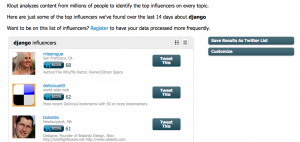
klout django influencers

klout django influencers

What happened is probably that she tweeted that keyword several days ago and the Klout engine pick it up, putting here in their Django topic basket and by looking at the outstanding number of followers she has, promoted her to the top of the list. A more complete analyze of her tweets would have been enough to avoid this error. Further analysis of shared link would be even better, but slightly more complex.

User Ranking methods and technology will most certainly become ubiquitous in a near future and evolve into something solid and relevant enough to be used as a content and conversation filter, as well as for targeted advertising purposes. A great example of the relevancy concept can be found in Traackr from which I just got a demo. They still do some manual intervention for quality assurance, but they have included a relevancy score related to the queried domain, as I would expect. We talked a little bit about their roadmap and they seems to have some pretty interesting stuff coming up.

Are you planning to use some kind of User Ranking in your applications or web strategies ? How ? What are you expecting from such tools ?

Reblog this post [with Zemanta]

No TweetBacks yet. (Be the first to Tweet this post)

View Comments

  1. 2/12/2009missrogue say:

    That's so odd. I don't think I've even mentioned Django before (maybe Django Reinhardt!). Totally broken! :)

  2. 2/12/2009jfbelisle say:

    You are so right Phil, thanks for sharing. What is also interesting here is that Klout seems to have changed their algorithm in the last few months. The “popularity vs. relevance” debate is an important one. Popularity is killing creativity, uniqueness and in some points expertise, while relevance is doing just the opposite.

  3. 2/12/2009philgo20 say:

    @missrogue : funny isn't it, I haven't been able to find the mention myself… but it's getting harder to search older tweets without the API.

  4. 2/12/2009philgo20 say:

    totally. What's good is that they contacted me and we shall chat on Friday, so I might have something to add here soon.

  5. 2/12/2009jfbelisle say:

    Quite interesting, we're talking about real impact

  6. 10/12/2009philgo20 say:

    Following this post, I was contacted by Joe Fernandez, CEO of Klout to tell me more about their platform. What I learnt is that the topic search was just recently launched and that they are monitoring it closely to make it as relevant as possible. I also learn that they do “some” semantic analysis of the link shared by Twitter, so the profile of the users and their influence domain is defined by more than just the tweets themselves.

    To be fair and to compare apples to apples, to actually build a list of influencers for the Django framework, I would need to to a couple more detailled search like : “django python”, “django programming”, “django blog development” and so on.

    Right now, there doesn't seem to be enough data yet to search for that in Klout Topic search. You will also need full boolean search to get the right level of precision at some point.

    Joe seems like a genuinely nice guy working on a missing piece of the conversation puzzle with a small team in SF.

    Here's some part of our exchange.

    What is your roadmap plan on gathering profile information from other network than Twitter ?
    JF: We are planning to release Facebook and LinkedIn data early next year.

    Do you check all links shared by registered users ? What do you check in links ? Keyword density ?
    JF: Depending on our processing load and the overall activity on twitter we are able to process varying % of links. Generally we get most of them and we are working to get them all. When we process the links we are performing semantic analysis where keyword density is one of the factors.

    Does the topic search allows boolean expression ?
    JF: Right now, no. Would like to add this down the road.

  7. 10/12/2009philgo20 say:

    Following this post, I was contacted by Joe Fernandez, CEO of Klout to tell me more about their platform. What I learnt is that the topic search was just recently launched and that they are monitoring it closely to make it as relevant as possible. I also learn that they do “some” semantic analysis of the link shared by Twitter, so the profile of the users and their influence domain is defined by more than just the tweets themselves.

    To be fair and to compare apples to apples, to actually build a list of influencers for the Django framework, I would need to to a couple more detailled search like : “django python”, “django programming”, “django blog development” and so on.

    Right now, there doesn't seem to be enough data yet to search for that in Klout Topic search. You will also need full boolean search to get the right level of precision at some point.

    Joe seems like a genuinely nice guy working on a missing piece of the conversation puzzle with a small team in SF.

    Here's some part of our exchange.

    What is your roadmap plan on gathering profile information from other network than Twitter ?
    JF: We are planning to release Facebook and LinkedIn data early next year.

    Do you check all links shared by registered users ? What do you check in links ? Keyword density ?
    JF: Depending on our processing load and the overall activity on twitter we are able to process varying % of links. Generally we get most of them and we are working to get them all. When we process the links we are performing semantic analysis where keyword density is one of the factors.

    Does the topic search allows boolean expression ?
    JF: Right now, no. Would like to add this down the road.

Write a comment:

blog comments powered by Disqus